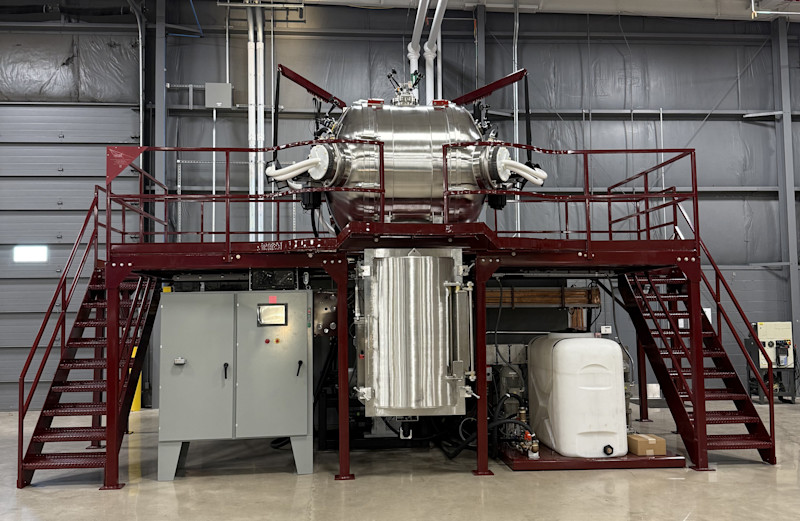
From replicators on “Star Trek” producing cups of hot chocolate out of seemingly nothing to Mega Man’s Mega Buster arm cannon drawing energy from thin air, science fiction has long imagined a world where matter bends to our whims – where anything you need simply appears when you need it. That fantasy has floated around for decades in movies, games, and books like “Ender’s Game.” Now, thanks to additive manufacturing (AM) and LIFT's latest initiative, the state-of-the-artAdvanced Metallic Production and Processing (AMPP) Center, it doesn’t feel quite so far-fetched.
To materialize this, the Detroit-based LIFT, one of the Department of Defense’s Manufacturing Innovation Institutes, is addressing one of the most critical bottlenecks in AM: the matter itself.
The Additive Revolution Meets a Supply Chain Roadblock
Metal AM has exploded in recent years, inspiring engineers, scientists, and designers to push the boundaries of what’s possible. Complex geometries, lightweight lattice structures, and custom alloys are no longer just thought experiments; they’re on drawing boards everywhere.
The catch? Those exotic alloys don’t exist in neat little bags of powder waiting to be fed into a printer. The supply chain for custom materials is limited and slow, if not practically nonexistent. If you do manage to find a supplier, you could be stuck with high minimum order quantities, 12-month lead times, and no guarantees of purity or consistency. Designing with bespoke, hypothetical alloys is akin to speccing custom wheels for a car without appropriately sized tires being available. (This is something that happens more frequently than you’d think – not just with exotics like Bugattis but even third-generation Honda Odyssey minivans!)
Skunk Works Vibes in The Motor City
Here’s where things get interesting. LIFT is like the Skunk Works of manufacturing, Lockheed Martin’s secret development team that created some of the most advanced aircraft ever built, including the SR-71 Blackbird and the stealth fighter. Born during World War II, Skunk Works became a symbol of rapid innovation: small teams, minimal bureaucracy, and bold engineering that often broke every rule to achieve what was previously impossible.
LIFT channels that same renegade mindset – fast-moving, boundary-pushing, and unafraid to experiment its way into breakthroughs. As a nonprofit public-private partnership Manufacturing Innovation Institute, it brings together industry, academia, and government to accelerate advanced materials and manufacturing process technologies. It not only orchestrates the rapid alloy-to-wire-to-powder chain through AMPP, but it also invests heavily in the human side of the equation. Their IGNITE: Mastering Manufacturing program, for example, engages high school students in real-world manufacturing skills – from Industry 4.0 data analytics and automation to materials science and hands-on projects – helping build the skilled workforce that will use tomorrow’s materials today.
And getting to tomorrow’s materials doesn’t begin with just fixing today’s alloy shortages; AMPP reimagines how we develop and source materials in the first place – no matter how remote the location.
Traditionally, creating new alloys was a long, expensive process reserved for the defense sector or major corporations with deep pockets and plenty of patience. But through initiatives like the Accelerated Development of Advanced Materials and Integrated Computational Materials Engineering (ICME) simulation software tools integrated with its Materials Informed Digital Acceleration Suite (MIDAS), LIFT cuts material development time and cost by up to 70%. Let’s call it the “MIDAS touch,” and not just because it’s a catchy phrase – it lowers barriers, reduces risk, and opens up the field to innovators who don’t necessarily have Ph.D.s (or a team of them) in metallurgy.
This is Detroit’s industrial DNA on display. The city that pioneered the assembly line is now helping pioneer the alloys – and workers – for those lines in the future.
AMPP: The Missing Link
The AMPP Center is a mini-infrastructure system for metals development, allowing innovators to go from alloy concept to usable powder without waiting a year or blowing their budget. So, what does that look like in practice? Here’s a flow example: Formulate an alloy; process it into wire; and then atomize it into powder with precision control over purity and particle size. The flow could also end after processing the alloy into wire; LIFT’s AMPP Center produces wire, powder, and rods. What sets the center apart is that it brings all these steps under one coordinated, domestic capability, enabling the rapid iteration of non-standard alloys, low-volume custom feedstocks, and accelerated delivery of materials tailor-made for advanced manufacturing rather than waiting on legacy supply chains or resorting to commodity alloys. In effect, instead of relying on existing powders and wires built for large-volume commodity use, AMPP lets manufacturers push new alloy chemistries straight from lab to feedstock with tighter control and faster turnaround.
The atomization capability is scalable and flexible – a “choose-your-own-adventure” model that adapts to whatever the user needs. It’s not an academic demonstration rig; it’s industrial-grade and nationally deployable. That last part is huge. Instead of being tied to a single, central supplier, the system can be dropped into place wherever it’s needed, ensuring a consistent supply for AM anywhere in the nation.
I’ve seen similar metal stock-to-powder workflows at places like Georgia Tech’s Advanced Manufacturing Pilot Facility, but LIFT’s approach is industrialized and battle-ready.
Why It Matters
The AMPP Center is more than another future-looking, defense-critical capability. It’s a statement: Manufacturing’s future won’t be defined just by flashy machines, robots, or software. It depends on the materials we actually build with and sourcing them – wherever they may be needed.
LIFT’s scalable, flexible, and reliable method for producing specialty alloys closes the gap between design and production. Engineers can now dream up next-gen parts knowing the powders and wires will be there when they need them.
And, by combining feedstock innovation and workforce development in one ecosystem, the company ensures that new alloys and processes don’t just sit on paper – they’re primed for use by people ready to deploy them. That’s why, when it comes to the future of advanced manufacturing, Detroit’s LIFT isn’t just keeping pace, it’s putting metal to the pedal.
Visit LIFT on this episode of the IMTS+ Original Series “Road Trippin’ with Steve."